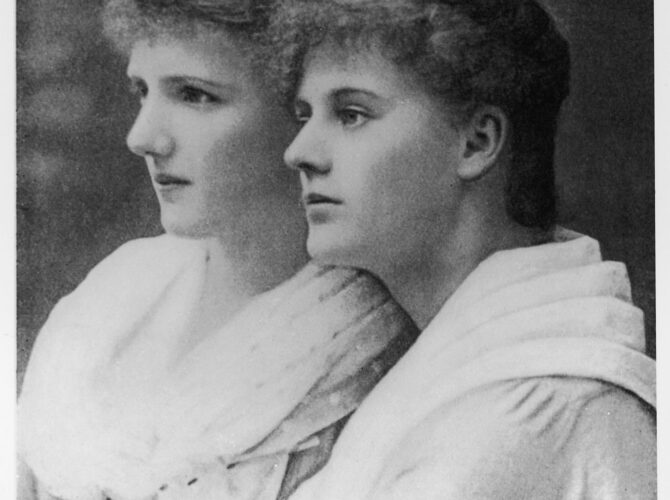

In Salford, Manchester, there is a bridge called Gore-Booth Bridge. The original structure has been replaced, but the name remains, preserving a link to the Gore-Booth family and to a wider story rooted in the city’s social history.
Among that family was Eva Gore-Booth, a figure whose life and work became closely connected with Manchester.
Born in 1870 at Lissadell House in County Sligo, Eva came from a privileged Anglo-Irish background. Her early life was far removed from the industrial streets of northern England, yet in the 1890s she chose to make Manchester her home. Alongside her partner, Esther Roper, she became deeply involved in campaigns that sought to improve the lives of working people, particularly women employed in the textile trades.
Manchester at the time was a city shaped by industry, where opportunity and hardship existed side by side. Eva and Esther worked closely with women workers, helping to organise trade unions and support collective action. Their efforts focused on practical change, from fairer wages to better conditions, giving women a stronger voice in workplaces where they were often overlooked.
Her campaigning extended into the movement for women’s suffrage. Eva argued that voting rights should be extended to all women, including those in low-paid work, rather than limited by property or status. This placed her among those pushing for a broader and more inclusive vision of political equality. Through writing, organising and public speaking, she became an important part of Manchester’s reforming networks.
Alongside her activism, Eva was also a poet. Her writing reflected many of the same concerns that shaped her public life, exploring ideas of justice, spirituality and equality. Together with Esther Roper, she helped to create a circle of influence that reached across labour reform, education and women’s rights, grounded in both principle and persistence.
Although she later returned to Ireland, Eva’s years in Manchester were among her most active and influential.
She died in 1926, leaving behind a legacy that combined literature with social change.