The Liverpool & Manchester Railway changed how people thought about distance, and about time. Every town and village had one or more public clocks, often in a church tower. These clocks were set using a sundial. But this meant that the further west you travelled, noon became later and later, so that in cities in the West of England like Bristol were ten minutes behind London and Liverpool six was minutes behind Manchester.
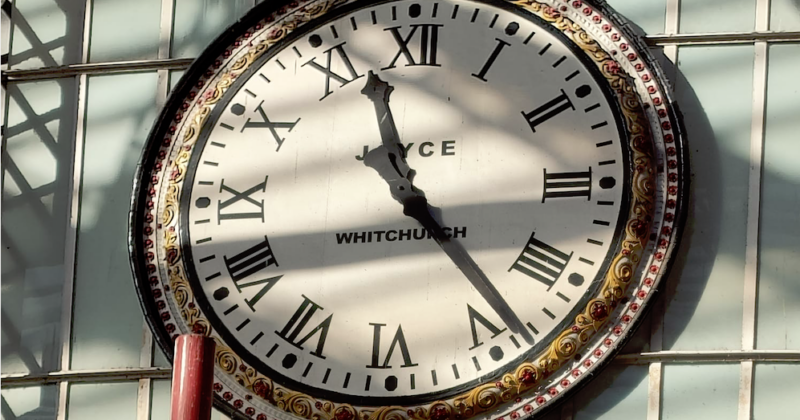
This really didn’t matter when people were travelling short distances or travelling slowly but suddenly it became important when trying to create a railway timetable. Trains needed to leave on time, but the question was: which time? A sundial was set up at Liverpool Road Station in Manchester so that passengers could tell the time, and later clocks were provided at Liverpool, Newton and Manchester but they weren’t set to a common time until 1841: they still showed local time. This not only presented a problem for passengers but for railway safety.
The Liverpool & Manchester Railway operated on a Time Interval System so that there was to be 20 minutes minimum between each train. Stationed every mile of the line was a Constable equipped with a watch, a set of coloured flags, a hand lamp, and a timetable. He was to come on duty before the first train of the day and go home after the last train had passed him. It was important he knew the time each train left and was meant to pass him so he could tell it to slow down (showing a green flag), to stop (red flag) or it was okay to proceed (white) flag.
Whilst his timetable may have said a train left Manchester at 8am, 8am was a different time in, for example, Newton Le Willows and a train which left Liverpool at 12noon was leaving at a different relative time to Manchester. If anything trains heading west would appear to be always late, and those running east, early!
The big problem then was, was that whilst the railway clocks were set to the same ‘railway time’, church and other clocks were not. This led to complaints in Manchester that passengers had missed their train. As the railway network grew, so this problem became bigger and bigger and more and more dangerous, so Henry Booth the Secretary, Treasurer and General Manager of the Liverpool & Manchester Railway took up the cause. In 1844 he proposed a national standard time for the railways based on London time, and in 1847 Greenwich Meantime was introduced which said that all clocks would be set to London time.